Timeless Jewelry:
Where Less Is Always More
Classic forms endure — the signet ring, the strand of pearls, the solitaire on a fine chain. Not because they are fashionable, but because they carry weight without shouting.
It’s the difference between confidence and compensation, between owning beauty and borrowing it.
There’s a particular quality to timeless jewelry worn well: it doesn’t announce itself from across the room, yet somehow you notice it anyway. Classic forms endure — the signet ring, the strand of pearls, the simple gold hoop, the solitaire worn on a fine chain. These pieces carry weight without shouting, history without fuss.
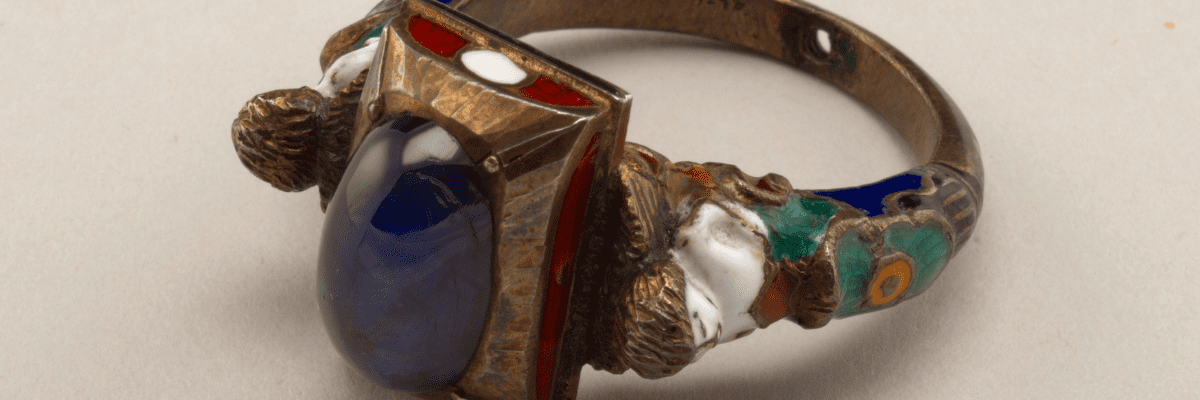
For my twenty-first birthday, I received a signet ring. I’ve worn it ever since — through elegant dinners in old castles and, less glamorously, while herding runaway pigs from a neighbour’s field. Nearly thirty years later, this piece of timeless jewelry is still flawless, not because it’s indestructible, but because it’s part of me. That’s rather the point of good jewelry, isn’t it? It becomes woven into the fabric of your life, much like timeless silver cutlery or cobalt blue porcelain.
I was raised with a simpler philosophy: to value what is truly ours, not what happens to be trending this week. By “truly ours,” I mean genuinely possessed — timeless jewelry with genuine stones, true metals, pieces that will outlast their owners and move on to the next generation with their lustre intact.
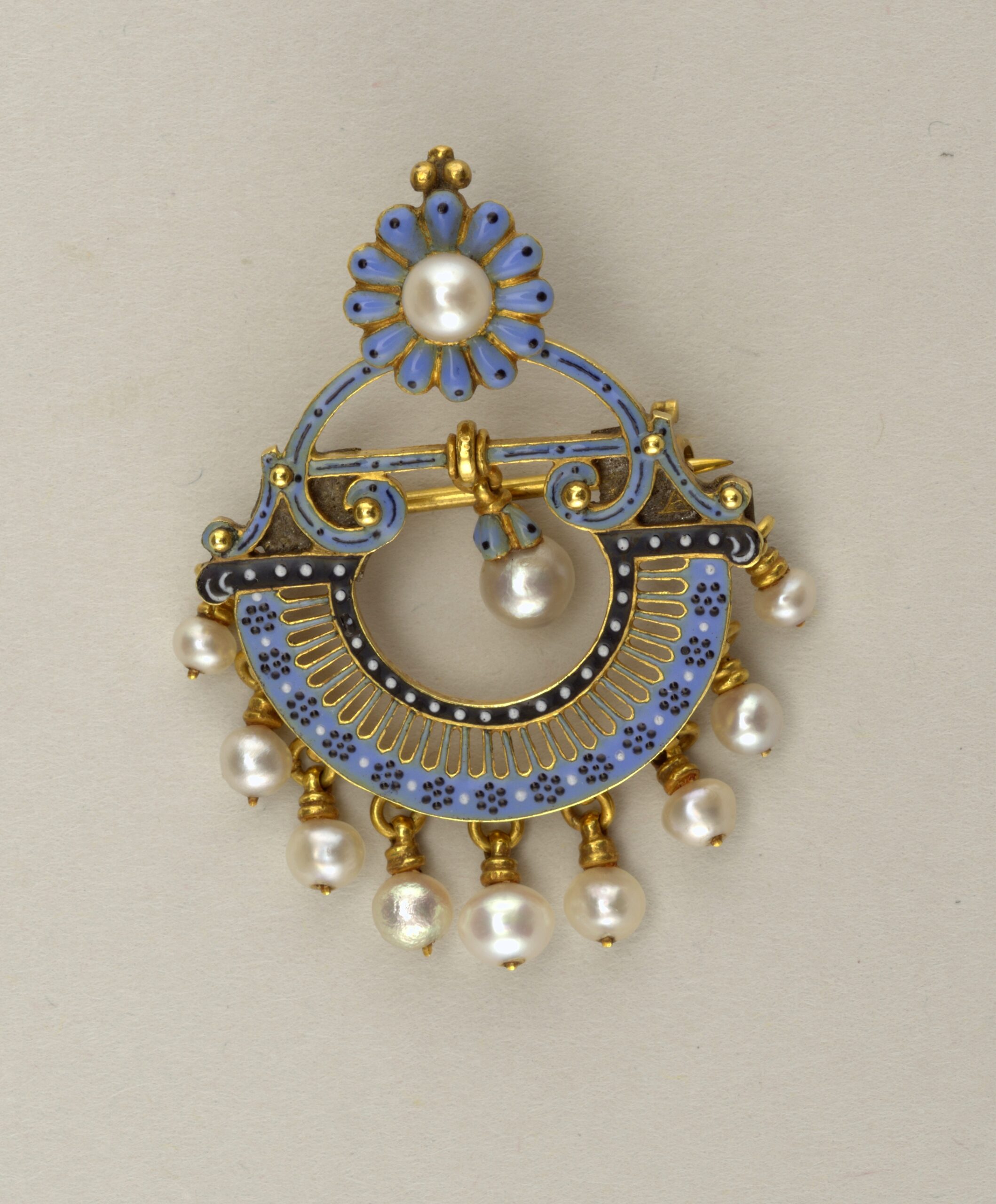
Timeless jewelry antique gold brooch with blue guilloche enamel and pearl flower details
Why Gold and Silver
Our ancestors understood something subtle about gold and silver — not merely that they didn’t tarnish or corrode, but that they suited different contexts, different moods, different purposes in ways we’ve largely forgotten to articulate. Gold carried qualities that made it appropriate for certain occasions: warming rather than cooling, radiant rather than reflective, suited to daylight and ceremony. It was the natural choice for formal presentations, official portraits, moments meant to project authority and vitality. Think of state jewels, coronation regalia, pieces worn in broad daylight when one wished to be seen.
Silver, by contrast, possessed a quieter character. Its cooling touch, its gentle lustre by candlelight, its quality of reflection rather than radiance — all made it the intimate metal. It harmonised with evening gatherings, private dinners, moments where closeness rather than ceremony was the aim. This is why family jewels were often silver while state pieces gleamed in gold. Not merely convention — practical wisdom, refined over centuries of observation.
The same principles extended to gemstones. Sapphires and pearls for evening wear weren’t fashion — they suited contexts where one sought calm, contemplation, quiet elegance. Rubies and garnets found their place in daylight hours, their warmth and intensity appropriate to active occasions. These weren’t superstitions. They were practical applications of knowledge our ancestors held instinctively — that certain materials harmonise with certain times, certain moods, certain intentions.
For Victoria
There’s a rather moving example from Victorian England that illustrates how materials suited specific contexts — not through arbitrary fashion, but through qualities our ancestors understood instinctively. After Prince Albert’s death in 1861, Queen Victoria wore only Whitby jet for four decades. Not because black was merely “appropriate” for mourning, but because jet possessed qualities that harmonised with the nature of grief itself. Jet is fossilised wood — transformed over millions of years from living tree to dense, cool stone. Its cool touch, its light weight, its deep black that absorbed rather than reflected light — all these qualities made it the natural choice for mourning.
By 1873, over fifteen hundred craftsmen worked in Whitby, carving jet into brooches, lockets, and rings — not as morbid decoration, but as tangible anchors for memory. When the mourning period ended with Victoria’s death in 1901, the demand collapsed almost overnight. Not because tastes changed, but because the context that made jet appropriate had passed. This wasn’t superstition. It was practical observation refined into tradition.
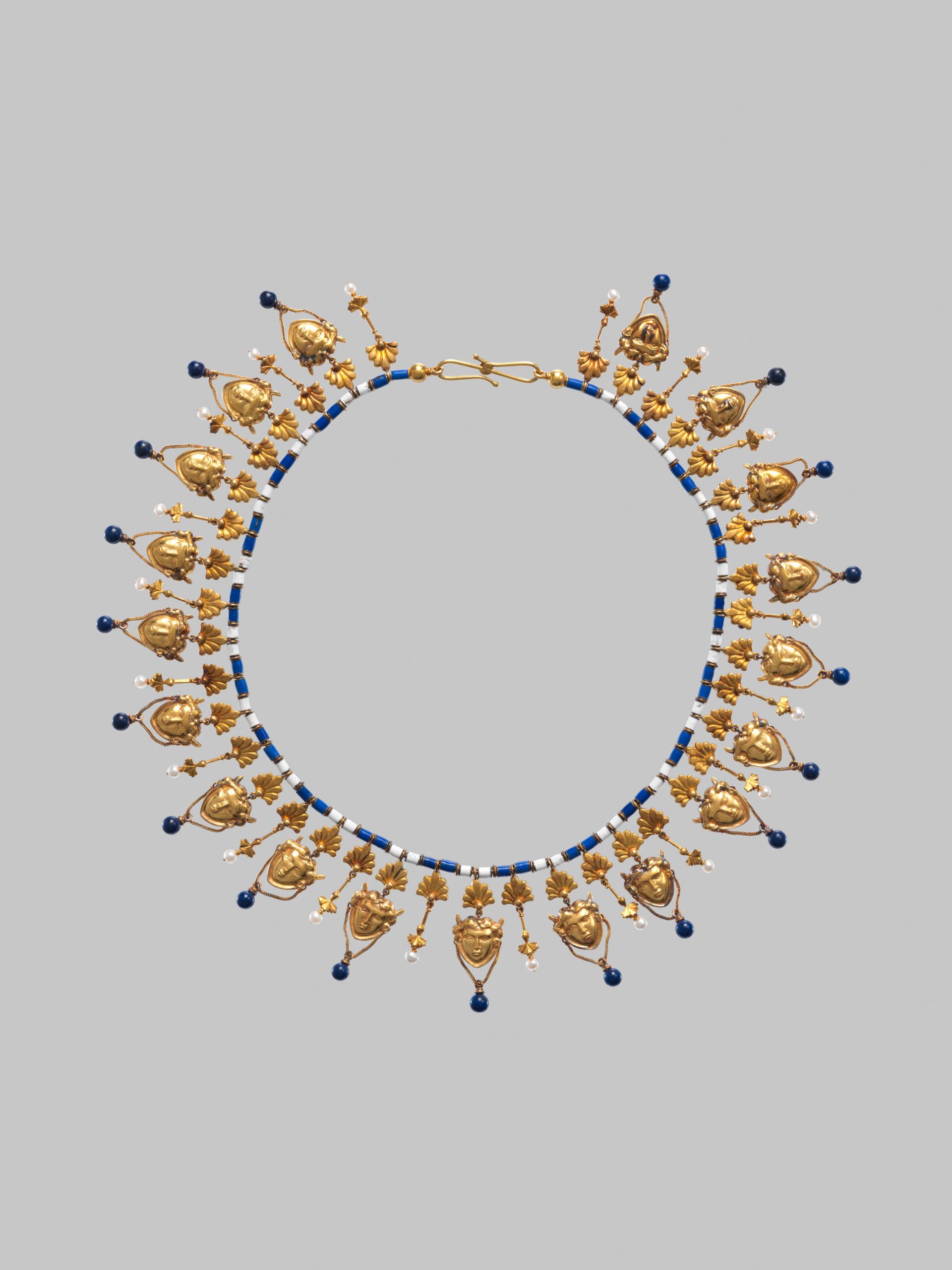
Egyptian Revival Lapis Lotus Necklace
For Justinian
Perhaps the most striking example of materials carrying inherent significance comes from Byzantine Constantinople. In 529 AD, Emperor Justinian codified what every aristocrat already knew instinctively: certain stones suited certain ranks not through convention, but through their very nature. The Justinian Code explicitly reserved sapphires, emeralds, pearls, and amethysts for imperial use. To wear purple amethyst without the emperor’s permission was a criminal offence — not because Justinian was petty, but because purple stones carried qualities associated with sovereignty itself. Deep purple signified wisdom, contemplation, and divine authority. To wear it was to claim those qualities.
Byzantine jewelry featured elaborate hierarchies of stones — sapphires for heaven, rubies for martyrdom, emeralds for paradise, pearls for divine light. Each piece was a wearable theology, a portable statement of cosmic order. The famous mosaics of Empress Theodora in Ravenna show her wearing precisely this hierarchy: emerald, pearl, sapphire pendant earrings representing paradise, purity, and heaven in descending order. The Byzantines understood something we’ve largely forgotten: that materials don’t merely symbolise attributes — they embody them.
The Wisdom of Wearing
One develops an eye for timeless jewelry over time. The woman who wears a single, exquisite piece speaks volumes. My guiding rule remains straightforward: wear only what’s real. The imitations don’t just cheapen the look — they can come back to haunt you. Gold plate wears through. Cubic zirconia loses its fire. And there’s something about paste jewelry that the eye registers, even when the mind hasn’t quite caught on. It reads as trying, and trying is the opposite of effortless.
Less, as the saying goes, is often more. One stunning piece outweighs a dozen mediocre ones. Quality needn’t mean enormous — a small, perfect diamond beats a large, flawed one every time. A simple gold band worn smooth with age carries more meaning than the flashiest bauble fresh from the jeweller’s window. When building a collection, consider not just what pleases your eye but what serves your life: a strand of pearls for evening, a simple gold band for daily wear, perhaps a sapphire for moments requiring calm and clarity, a garnet when you need warmth and courage. These aren’t mystical notions — they’re observations refined over generations, now largely forgotten in our eagerness to wear everything all at once.
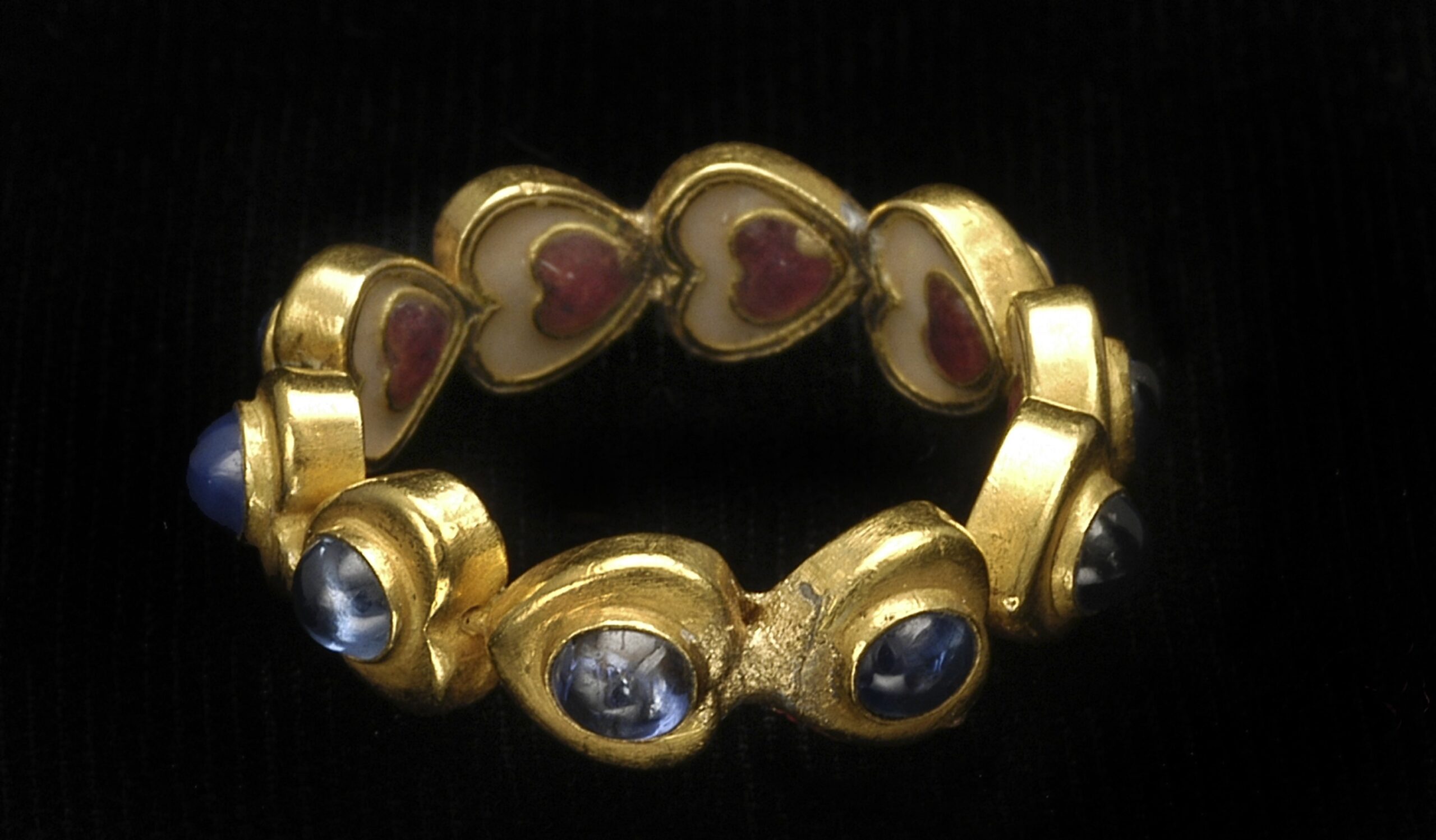
Antique gold ring with heart-shaped enamel segments and cabochon sapphires on black background
If you’re just starting to build a collection — or rather, to curate one, which is the more appropriate term — consider what will serve you across decades, not seasons. Inherited pieces always hold the deepest sentiment, naturally. But not everyone has an heirloom to cherish, and that needn’t be a loss. Antique dealers offer their own kind of inheritance. You can stumble upon small treasures there, or take inspiration from a photograph to a trusted goldsmith and have something made that’s entirely your own.
And when you find something that speaks to you — something that feels right in your hand and on your person — trust that instinct. Jewelry, like friendship, should feel easy once you’ve found the right match. It shouldn’t demand constant adjustment or second-guessing. It should simply be there, quietly enhancing rather than overwhelming.
In the months ahead, I’ll be sharing some particularly fine dealers and pieces worth falling in love with. For now, start where timeless beauty truly lives — with antiques that continue to whisper their secrets to today’s most discerning collectors.
Similar Posts
Quiet Luxury: A Curious Paradox
ABOUT Quiet Luxury:A Curious Paradox We are besieged by endless pings and pop-ups — yet the more digital our days become, the stronger our longing grows for what truly endures. By Maria von Maltzahn · January 2026 Authentic luxury whispers rather than shouts. It resides in the weight of properly made linen, in the patina…
Persian Carpets: Empire-Enduring Artistry
Residences Persian Carpets:Empire-Enduring Artistry On the quiet authority of the world’s oldest textile tradition — and how to choose one that will outlive you. By Maria von Maltzahn · January 2026 The best Persian carpets aren’t bought — they’re chosen. One encounters Persian carpets in the most unlikely places — softening stone floors in country…
Cobalt Blue Porcelain: A Journey of Royal Whisper
COLLECTING Cobalt Blue Porcelain:A Journey of a Royal Whisper From Persian mines to Chinese imperial kilns to European manufactories — the story of a blue that travelled further, and cost more dearly, than most people realise. By Maria von Maltzahn · February 2026 Extraordinary, really, what people will endure for beauty. That particular shade of…
Linen Fabric and the Art of Natural Luxury
LIVING Linen Fabricand the Art of Natural Luxury Among nature’s oldest and strongest threads, linen carries a lineage that predates civilisation itself — and asks almost nothing in return. By Maria von Maltzahn · February 2026 To choose linen is to choose longevity, simplicity and light — qualities that never go out of style. There…