Rock Crystal Glasses:
The Finest Drinking Vessels
Hold a piece up to candlelight. The light does not simply pass through it. It lingers — as though the stone is in no particular hurry. Which, of course, it isn’t.
Rock crystal is what one acquires when one has ceased searching. Nature kept the final word.
There are objects you hold and immediately understand: this is different. Not more expensive. Not more beautiful, necessarily. Different in the way that a stone worn smooth by a river is different from a stone cut by a machine — both are stones, both have their place, but only one of them carries time in it. Rock crystal is that kind of different.
Hold a piece up to candlelight. Not the finest cut crystal glass from the cabinet — proper rock crystal, carved from a solid block grown in the earth over millions of years under immense pressure. Something rather curious happens: the light does not simply pass through it. It lingers. It moves through the material as though through something alive — unhurried, cool, wholly itself. As though the stone is in no particular hurry. As though it has all the time in the world. Which, of course, it does.
Crystal glass is a beautiful material. The finest pieces — a mouth-blown Lobmeyr goblet, a hand-cut Baccarat coupe, a Riedel Sommeliers glass with its impossibly considered proportions — possess a clarity and a ring when touched that has few rivals at the modern table. But crystal glass is, for all its loveliness, reproducible. Rock crystal glasses belong to a different category entirely — not of luxury, but of kind.
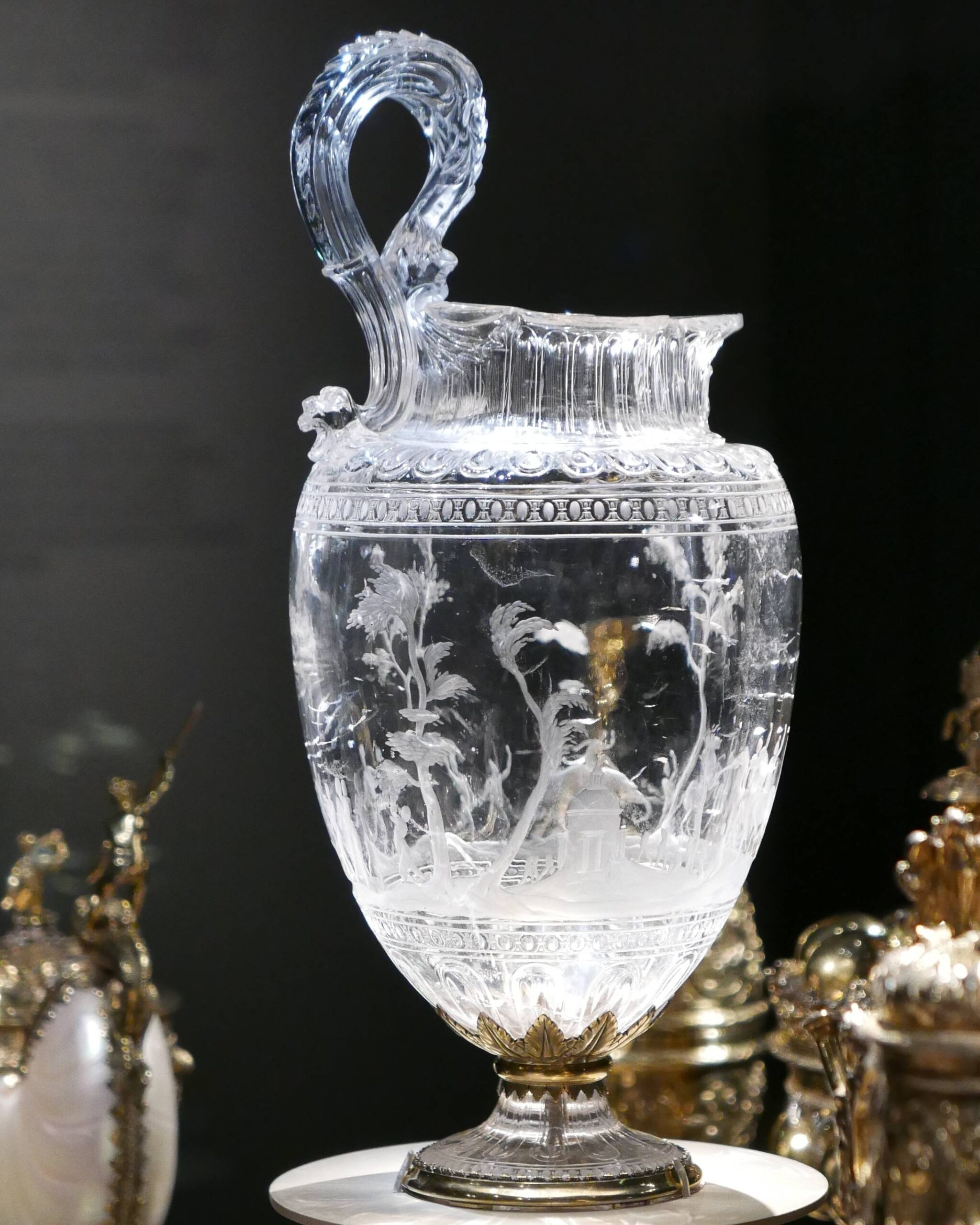
Historic rock crystal and vermeil ewer by Francesco Tortorino Milan 1550, antique carved rock crystal glasses
What Rock Crystal Glasses Actually Are
Each block of natural quartz is unique. The faint inclusions inside a genuine piece — the clouds, the rutile needles, the ghostly internal landscapes — are not flaws. They are the earth’s own signature. A record of the precise conditions, the exact pressures, the particular moment millions of years ago when this specific deposit of silicon dioxide began to form. No two pieces are alike. They cannot be. And unlike glass, rock crystal cannot be blown or cast or pressed into a mould. It can only be worked subtractively: carved, millimetre by millimetre, from a solid block. The Roman craftsmen who made such things — the gemmarii — required weeks for a single drinking vessel. One can still find, on original pieces examined closely, the microscopic traces of the lathe. Handwriting, in stone.
When you hold a rock crystal glass, you are holding the end of a very long tradition of human wanting.
The Company One Keeps
There is a particular pleasure in knowing who has drunk before you. Rome’s wealthiest kept entire table services in rock crystal. Nero possessed cups in the material that, upon receiving news of his imminent downfall, he smashed in a fury — his final act of vengeance upon mankind, Pliny the Elder records, so that no one might ever drink from them again. Rock crystal cannot be mended. That is part of its nature. One possesses something perfect, or one does not. Pliny himself notes what the Romans understood instinctively: the material suited cold drinks only, in keeping with its nature as frozen celestial water. No warm wine in rock crystal. The vessel dictated its own use. The substance had opinions.
A thousand years later, in Fatimid Cairo, the imperial treasury held some 36,000 pieces in rock crystal. The Arab historian al-Maqrizi records the Fatimids’ own name for it: Busaq al-qamar — the Spirit of the Moon. The transparency of rock crystal struck them as so wholly other — so unlike ordinary stone, so unlike anything the hand of man could produce — that they associated it with moonlight itself. With purity. With water. With everything clear and cool and unequivocally true. Those Fatimid rock crystal ewers now sit in the treasury of the Basilica of San Marco in Venice, in the Louvre, in the Abbey of Saint-Denis in Paris — where one arrived as a wedding gift between royal houses. Rock crystal was diplomatic currency. What one gave to someone to whom one wished to say something lasting.
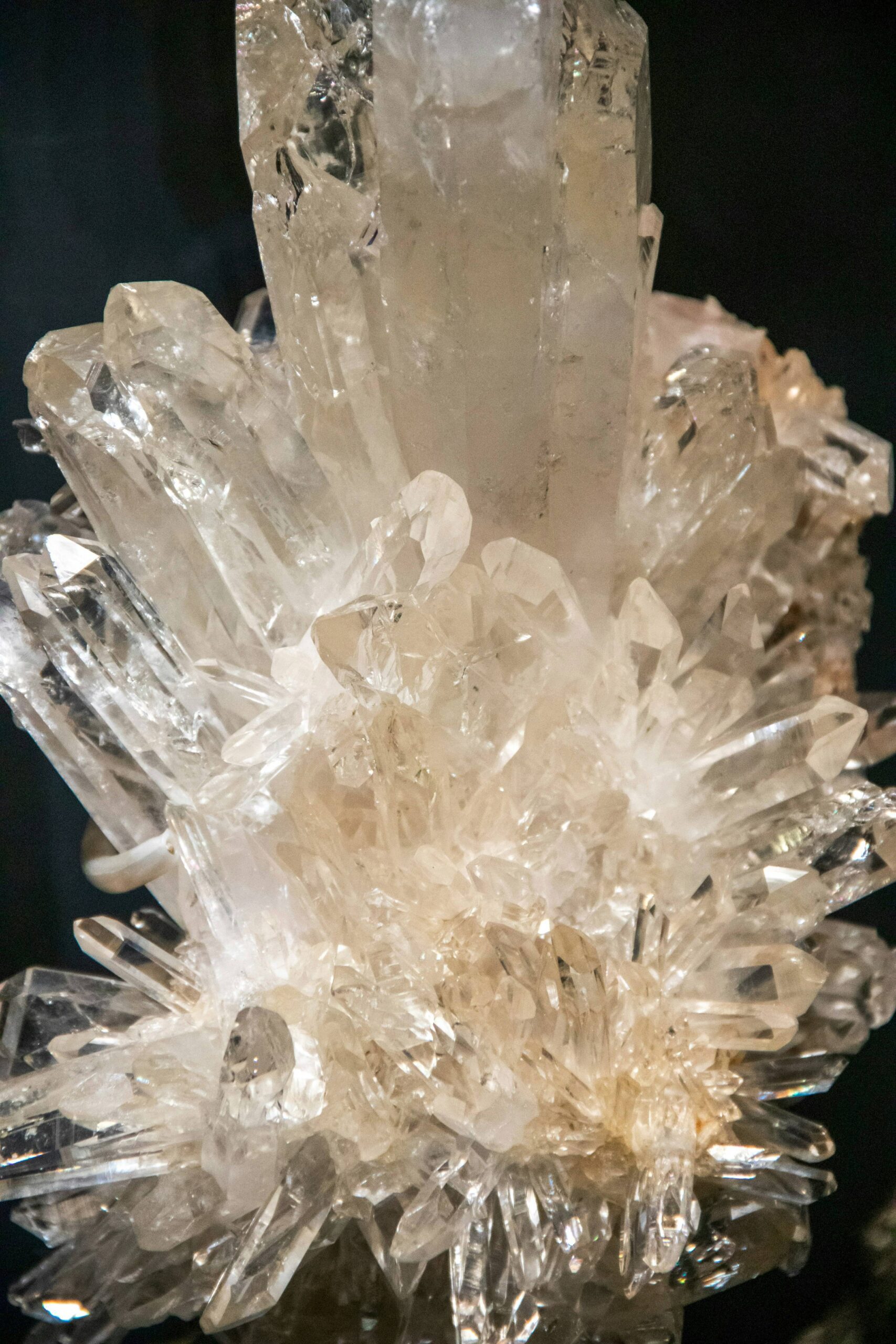
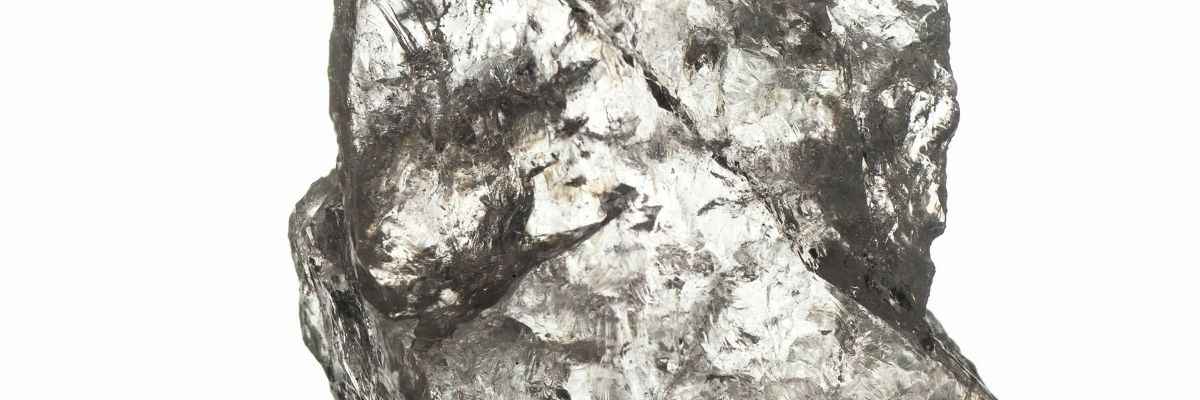
Natural rock crystal cluster with pointed quartz formations, raw material for carved rock crystal glasses
What Our Ancestors Understood
Our ancestors noticed — without laboratory conditions, without being able to articulate precisely why — that certain materials harmonise with certain moments. Rock crystal, with its qualities of cool stillness and luminous depth, was the instinctive choice for water and for those drinks taken pure. Not on grounds of fashion. On grounds of an observation refined over generations: the vessel altered the experience of drinking itself.
This remains perceptible today. Those who drink from genuine rock crystal report — consistently, and often with some surprise — that water tastes different within it. Cooler, somehow more itself. As though the vessel clarifies rather than merely contains. This is not poetic licence. It is the physical reality of a pore-free, non-reactive mineral grown in the earth for millions of years, unchanged and unchangeable. The great households kept rock crystal for water and for certain wines, for private moments rather than state banquets. For banquets, there was gold and silver. Rock crystal was quieter, more intimate, more personal. For the dinner where one actually wished to be present. For the gift to the person who already has everything — and who will understand, when they hold this, that they have been given something that cannot be replicated.
A Word of Caution — Because It Matters
The confusion between rock crystal and crystal glass is not a minor misunderstanding. It is rampant, it is expensive, and it is entirely possible to spend a significant sum on something that is not what you believe it to be. Even on distinguished platforms, the term “rock crystal” is used with a looseness that would have bewildered Pliny. Thomas Webb & Sons — one of England’s most celebrated Victorian glassmakers — produced some of the most beautiful drinking vessels of the nineteenth century. They are genuinely treasured, genuinely collectible, genuinely worth thousands. But they are crystal glass. Webb’s own catalogue described the style as “rock crystal engraving” — meaning the cutting technique, not the material. The name stuck. The distinction blurred.
The test is simple: a genuine rock crystal vessel is carved from a single solid block of natural quartz. Not blown, not cast, not assembled. It will be cool and heavy in the hand in a way that no glass achieves. It will have the faint irregularities — inclusions, internal light-shifts — that are the earth’s own mark. And it will not, under any circumstances, be available in a set of twelve for a reasonable price.
Pliny wrote, in the first century, of what he considered the paradox of rock crystal: that glass vessels had achieved a marvellous resemblance to it — and yet, wonderfully, had only raised their own value, without diminishing crystal’s in the slightest. Two parallel worlds that do not touch. That holds today.
Frozen celestial water, the Romans said. Spirit of the Moon, said the Fatimids. Frozen earth, says Alexander Lamont. What each of them meant was the same thing: something the earth itself made, over more time than we can properly imagine, for no human purpose whatsoever — and which we, with considerable audacity, decided to drink from. The finest glass is not a glass at all. There you have it, darlings.